The New Bark City Health Library
August 2026: Respiratory & Allergic Emergencies
Hey guys! For August, September, and October, we are going to review some of the emergency flyers that we keep right on the wall here at New Bark City. Since this is our teaching library, we want to dive a little deeper and elaborate on what these situations look like so you feel prepared and informed.
We hope you find this helpful! Featuring our trusted partners—like Good Shepherd Pet Hospital and BluePearl Pet Hospital—also highlights who we rely on for our critical medical cases, which is wonderful for our community network and grant writing.
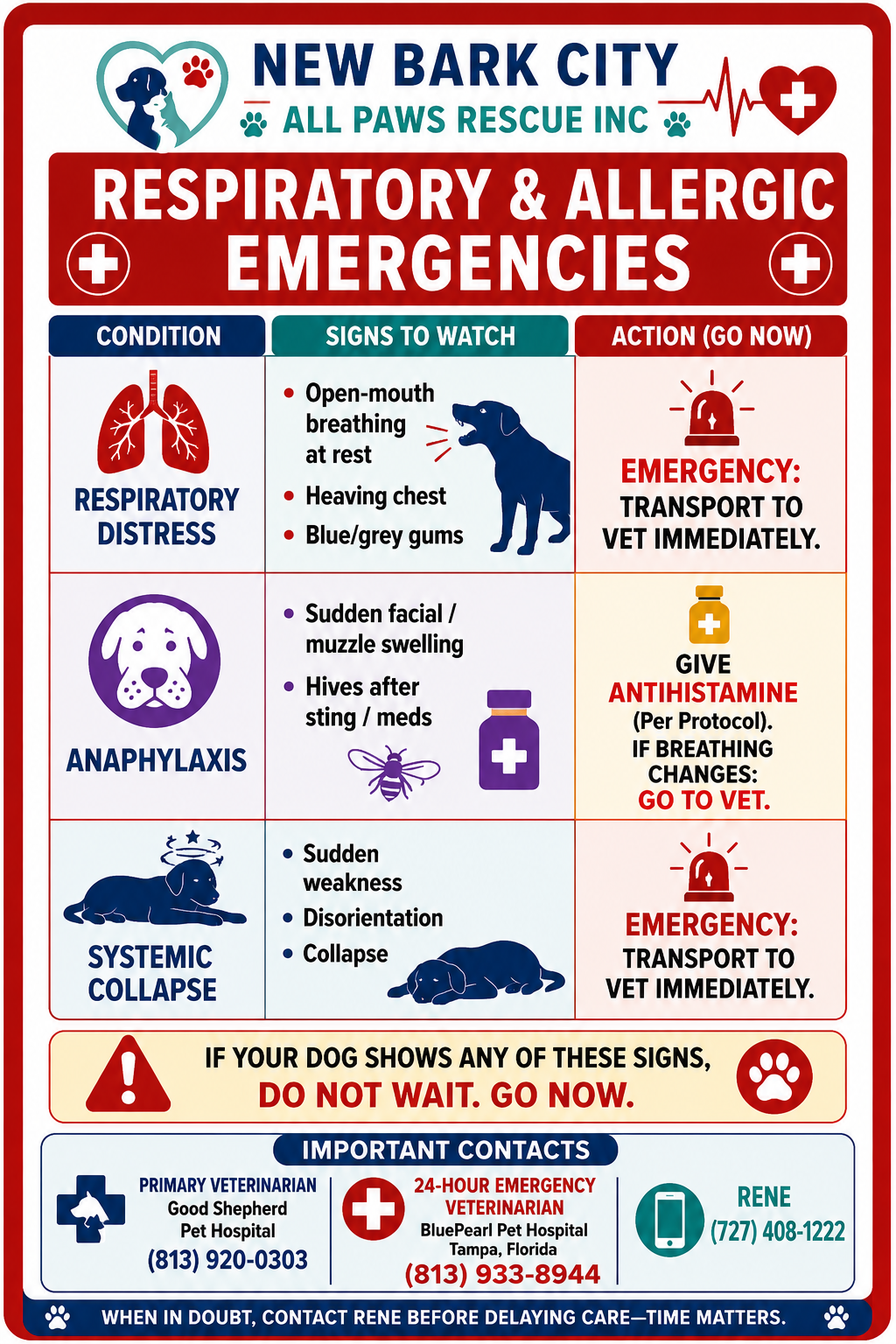
Here is a closer look at what to watch for and how to handle respiratory and allergic emergencies:
Respiratory Distress
What it looks like: You might notice open-mouth breathing while the dog is completely at rest, a heavily heaving chest, or gums turning a blue or grey shade.
Action to take: This is an immediate, critical emergency. Transport your pet to the vet right away.
Anaphylaxis (Severe Allergic Reactions)
What it looks like: Keep an eye out for sudden facial or muzzle swelling, or hives popping up after an insect sting or a medication.
Action to take: Administer an antihistamine following your vet's protocol. If their breathing changes or worsens, head straight to the vet.
Systemic Collapse
What it looks like: Sudden, severe weakness, disorientation, or a complete collapse.
Action to take: Do not wait—this is an acute emergency requiring immediate transport to the hospital.
July 2026: Summer Safety Protocols
Topic: Protecting Your Pack from Florida's Extreme Heat
Beyond the immediate dangers of leaving a pet in a parked vehicle, the summer months in Florida present daily hazards that require proactive care. Education is the most effective tool we have to prevent heatstroke and keep our rescue heroes safe.
The Dangers of Heat Accumulation
Parked Vehicles: Regardless of whether the day is cloudy or windows are cracked, interior temperatures can climb to 100°F in ten minutes and exceed 116°F within an hour when outside temperatures are 90°F.
Physiological Limitations: Dogs regulate their body temperature primarily through panting rather than sweating, causing them to overheat much faster than humans.
Recognizing Emergency Symptoms: Heatstroke is a severe medical emergency; owners should look for excessive panting, drooling, vomiting, extreme restlessness, physical weakness, or total collapse.
Summer Protocols at New Bark City
Modifying Activity: From June through August, we strictly limit outdoor time and move most activities indoors to keep our dogs safe.
Exposure Limits: No dog should be left outside for long periods during these months, even with shade, as "feels like" temperatures often reach 105°F.
Safe Walking & Exercise: Avoid walking on hot asphalt to prevent paw burns, or use protective footwear. Always carry water and a bowl, and skip high-intensity exercises like jogging or bike riding during the heat of the day.
Indoor Care: Even for indoor dogs, maintain proper hydration and provide air-conditioned environments whenever possible.
Nurse's Tip:
The most important rule is to be proactive; whether it’s avoiding hot pavement, skipping strenuous activity during peak heat, or simply keeping your companion inside, you are their voice and their protection.
June 2026: Understanding FAS (Fear, Anxiety, and Stress)
At New Bark City, we believe every dog deserves to be understood. When you see a dog in a shelter struggling, it is often because they are experiencing high FAS—Fear, Anxiety, and Stress.
What is FAS?
FAS is a medical-behavioral rating used to identify a dog's emotional state. It helps us understand that a dog isn't being "bad"—they are simply in survival mode.
Low FAS (0–1): The dog is relaxed and comfortable.
Moderate FAS (2–3): The dog may be hesitant, less interested in treats, or showing mild stress signals like tucked tails or ears back.
High FAS (4–5): This is a "stop" level. The dog is in extreme distress, which may show up as freezing, trembling, excessive panting, or fear-based behaviors like growling or snapping to protect themselves.
Why It Matters
Survival Mode: Dogs with high FAS are overwhelmed by their environment.
Specialized Care: Because these dogs are in survival mode, they often require a slower, gentler approach and a calm, structured environment to decompress.
Medical-Grade Support: High FAS is a real, measurable condition that requires patience, decompression time, and sometimes veterinary support to help the dog feel safe again.
Store:
Nurse's Tip: Understanding FAS is the first step in unlocking a dog's potential. When a dog is in a state of high Fear, Anxiety, and Stress, they aren't "bad"—they are just in survival mode. Giving them space and a structured, quiet environment is the best way to help them decompress.
May 2026: Spotting the "Silent" Killer
Topic: Early Signs and Symptoms of Parvovirus
Parvovirus moves with terrifying speed. For the average pet owner, the difference between a "stomach bug" and a Parvo emergency can be hard to distinguish until it’s too late. Education is the first line of defense; knowing the subtle early markers can save a life before the virus causes irreversible damage.
The Nurse’s Insight: In a clinical setting, we look for the "Lethargy Lead-In." Before the gastrointestinal symptoms start, most dogs will show a sudden, profound drop in energy. If a normally spunky puppy becomes "flat" and loses interest in their favorite high-value treat, it is a clinical red flag. This is often followed by a refusal to drink water and a specific, sour odor in the breath or stool. If you suspect Parvo, the only correct action is an immediate trip to a veterinary hospital. This is a medical emergency that requires professional fluid therapy and stabilization; it cannot be "waited out" at home.
Nurse’s Tip
If your dog shows sudden lethargy followed by vomiting or "tucking" their abdomen in pain, do not offer food. Instead, check their hydration by looking at their gums—if they feel tacky or dry to the touch, your dog is already in a state of dehydration. The goal isn't to treat the symptoms yourself; it's to get them to a professional who can manage the "ins and outs" before the virus shuts down their system.
April 2026: The "GI-Behavior" Connection
Topic: Managing the Sensitive "Rescue Tummy"
In the high-acuity world of Red-Listed rescue, we often see a direct correlation between gastrointestinal distress and behavioral outbursts. When a dog like Arlo or Asta Ray is uncomfortable internally, their "fuse" becomes much shorter, leading to barking, restlessness, or destruction.
The Nurse’s Insight: In a clinical setting, we don't just treat the behavior; we look for the source of the discomfort. We recognize that "behavioral issues" are often symptoms of physical distress. By implementing a GI-support protocol—using specific cooling and soothing ingredients—we can lower the dog's baseline stress level. Stabilizing the gut is the first step toward stabilizing the mind.
Nurse's Tip
When a dog is acting "out of character" or suddenly destructive, check their hydration and digestion first. Using a frozen tool like our April Tummy Tamer Ice Drops provides immediate physical relief and a sensory "reset" that can prevent a behavioral escalation before it starts
March 2026: Managing Steroid Side Effects
Topic: Understanding the "Panty & Thirsty" Phase
Many of our most intensive medical cases require steroid protocols to manage inflammation, skin issues, or autoimmune responses. While these medications are life-saving, they often cause "The Big Three" side effects: increased thirst, frequent urination, and heavy panting.
The Nurse’s Insight: It is easy to mistake steroid-induced panting for anxiety or stress. In a clinical setting, we recognize this as the body’s metabolic response to the medication. Instead of increasing "decompression" time, we increase physical comfort. Ensure your pup has 24/7 access to fresh water and use "cooling interventions"—like frozen meal toppers—to help regulate their temperature without adding more stress to their system.
Nurse's Tip
For dogs on long-term steroids like Winnie or Trina, keep a "Cooling Station" in your home. A simple fan or a freezer stocked with our March Skin-Support Pawsicles can make the difference between a restless dog and a comfortable one.
February 2026: The "70-Day Myth"
Topic: Understanding the Decompression Timeline
One of the most dangerous phrases in rescue is "they’re just shutting down." While a dog does need a "decompression" period, many adopters and shelters use "shutdown" as a permanent excuse for behavioral issues.
The Nurse’s Insight: In our clinical observation, there is a distinct 70-day marker. By day 70, a dog is no longer "decompressing"—they have acclimated. If you are still seeing the same negative behaviors at the 70-day point, it is no longer a "shutdown" issue; it is a behavioral or medical issue that requires a specific care plan. We teach our partners and adopters to track these milestones so we can intervene with the right support at the right time.
Nurse's Tip
When tracking the 70-day marker, keep a simple "Daily Care Log". If the behaviors haven't shifted by the end of month two, it's time to stop waiting for "decompression" and start a clinical intervention.
January 2026: The Medical Intake
Topic: Beyond the Shelter Scan
At New Bark City, we specialize in "Red-Listed" animals—the ones scheduled for euthanasia because they require intensive medical or palliative care. The first 24 hours of a medical intake are the most critical for setting a baseline for recovery.
The Nurse’s Insight: A standard shelter scan often misses the nuances of chronic pain or internal inflammation. Our protocol includes a full "Nose-to-Tail" clinical assessment. We don't just look at the injury; we look at the dog's mobility, coat health, and emotional responsiveness. By identifying these baseline markers immediately, we can create a specialized care plan that moves a dog from "at-risk" to "in-recovery" much faster.
Nurse's Tip
Always keep a dedicated "Intake Log" for the first week of any new foster. Tracking small details—like how many times they drink or how deep they sleep—provides the data we need to adjust their medical-grade care and recipes for the best possible outcome.